


Aviation Design Agency
Branding and Webflow websites for aviation businesses — charter and private aviation, MRO, urban-air-mobility, defence-aerospace, flight training and drone/UAV startups. Built to land with regulators, enterprise buyers and tender committees, not just to look like a stock-photo cockpit.



Why aviation companies struggle with branding and websites
Aviation has a uniquely conservative buying committee. A charter operator selling to a corporate flight department is being evaluated by a flight ops lead, a CFO and an internal travel-risk officer. An MRO selling to a fleet operator is being evaluated by maintenance directors, procurement and the airline's safety auditor. A defence-aerospace startup selling to the MoD is being evaluated by a tender committee, a technical-evaluation panel and a strategic-affairs office. A flight training academy is being evaluated by parents, students, and the regulator certifying the school.
In every case, the website is a credentialing document before it is a marketing site. The buyer is checking that the company is real, that the people running it have aviation backgrounds, that the operational footprint matches what's claimed, that the certifications and ratings are current, and that the firm survives a basic safety-and-compliance review.
The failure pattern is the inverse: aviation websites are typically over-designed and under-credentialed. A cinematic homepage video, golden-hour runway photography, large display type — and three clicks deep, there's no operational data. No fleet detail, no maintenance certifications, no training affiliations, no MoD tender history, no DGCA or FAA registration numbers. The credentialing data is what the buyer needed; the cinematic homepage was what the buyer scrolled past.
The second failure: defence-aerospace cliches. Stealth-fighter silhouettes, hexagonal background patterns, slate-grey palettes, eagle iconography. The buying audience — the actual MoD tender committee — has read those exact aesthetics on every defence vendor's site for the last twenty years. They no longer signal anything. Differentiation has to come from operational substance, not visual codes.
What goes wrong on most aviation sites
Stock-photo aviation aesthetics. Cockpit shots, golden-hour runway photos, contrails through cumulus. Indistinguishable from a hundred operator sites globally. The buyer cannot tell whether the operator has 3 aircraft or 30.
Missing operational substance. Fleet pages without tail numbers, maintenance pages without certification IDs, training pages without instructor credentials, tender-relevant pages without the actual tender history. The data that qualifies the buyer is missing.
Regulatory ambiguity. Sites that don't surface DGCA, FAA, EASA or equivalent registrations clearly. The buyer's first compliance check fails at the site and the call doesn't happen.
One-audience design. A site optimised for one buyer (say, the retail charter customer) when the company actually sells to four different buyer types (corporate flight departments, charter brokers, fleet partners, regulators). Each needs a navigable path through the site.
How Everything Design approaches aviation work
We start by mapping the buying audience. For a charter operator, that's usually four reader types: corporate flight departments, high-net-worth direct buyers, charter brokers, and partner operators. For an MRO, it's airlines, fleet operators, OEM partners and regulators. For a defence-aerospace startup, it's the MoD tender committee, strategic-affairs offices, institutional investors and recruiting candidates. Each gets a reading path through the site.
From there, we build positioning that leans into operational substance, not aviation aesthetics. The site is structured to surface the credentialing data the buyer is actually checking — fleet detail, certifications, operational footprint, regulatory standing, named leadership with aviation backgrounds — before it surfaces marketing narrative. That doesn't mean the site looks bureaucratic; it means the visual system has to serve the substance.
We build on Webflow with a CMS structured around fleet, locations, services, certifications and people. As the operator adds an aircraft, opens a new base, renews a certification or hires a new chief pilot, the site updates without a development cycle.
We write to aviation vocabulary. Type ratings, ATPL, AME licenses, Part 145 certification, Part 135 versus Part 121 operations, MoD versus DRDO procurement context, DGCA Civil Aviation Requirements. The buyer reads the site for vocabulary fit. Generic copy fails that test in the first two paragraphs.
One deliberate constraint we hold: we don't use motion gratuitously. Aviation buyers reading the site are usually reading on the operator's laptop, mid-task, between flights or between tender meetings. Heavy animation reads as a budget problem. We use motion where it earns its place (fleet detail, route maps, 3D aircraft renders for product-pages where relevant) and stay still everywhere else.
Named clients and case study highlights
Armory — defence-aerospace, the only Indian company building counter-drone systems entirely in India, with a major MoD tender already secured. We rebuilt brand and Webflow for a company that had to communicate sovereignty and operational capability to the MoD tender committee, strategic affairs offices and institutional investors in the same site visit. The brand resists commodity-defence aesthetics and lets the operational substance lead.
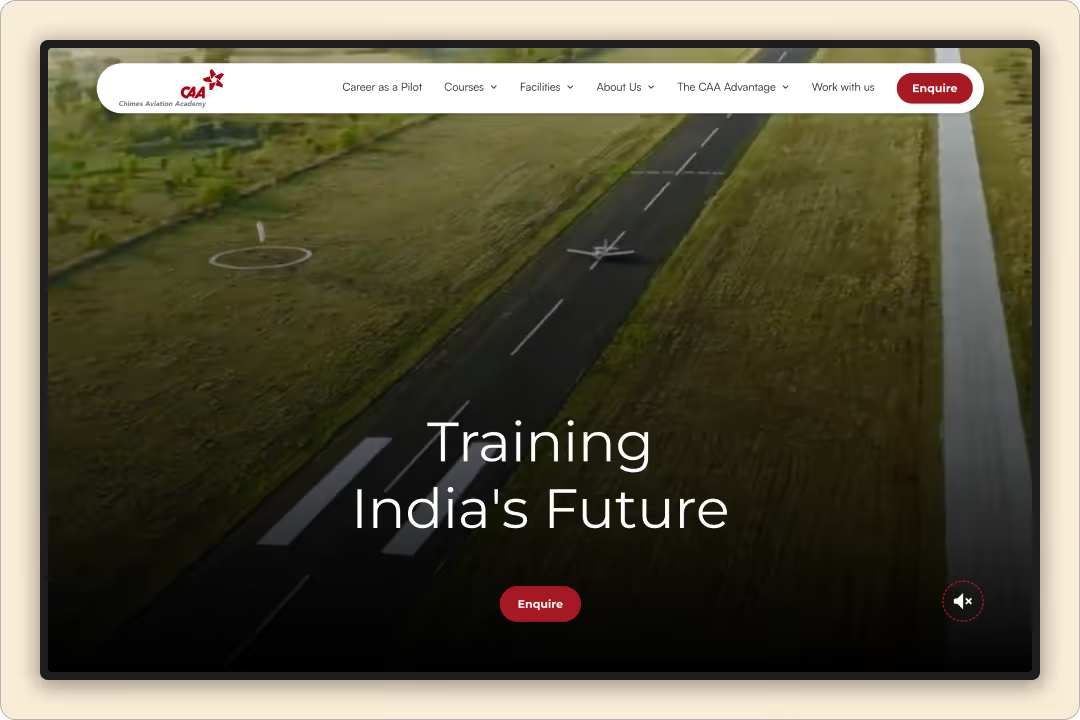
Chimes Aviation Academy — flight training. We worked through how a flight school presents itself to parents, prospective students and regulators in one architecture. The site had to satisfy a parent making a multi-lakh decision, a student researching career outcomes, and a DGCA inspector verifying credentials.
We've worked across adjacent aerospace and defence-tech engagements where we cannot name clients publicly — counter-drone, drone manufacturing, payload integration, satellite-comms aerospace, urban-air-mobility startups. We can walk through that work on call under NDA.
Best for
Best for defence-aerospace and counter-drone startups raising Series A-C. Where the brand has to land with the MoD tender committee and an institutional investor in the same site visit, and where commodity-defence aesthetics are actively damaging.
Best for charter, private aviation and fractional ownership operators. Where the buyer is a corporate flight department or a high-net-worth direct buyer and operational substance has to lead.
Best for flight training and MRO businesses scaling beyond a single base. Where the site is the credentialing document parents, students, airline partners and regulators all check.
Best for urban-air-mobility and drone-services startups. Where the category is new, the regulator is still defining rules, and the brand has to communicate seriousness to investors, certifying bodies and early commercial customers at once.
We are not the best fit for hobby drone retailers, model-aviation clubs, or pure consumer travel-booking sites. We're built for the operational and B2B end of the sector.
What's included
A typical aviation engagement covers:
- Audience and buyer-committee mapping
- Brand strategy (positioning against the operator's actual competitive set)
- Verbal identity (aviation vocabulary, regulatory-grade language, named-leadership voice)
- Visual identity (logo, type, colour, photography direction, iconography)
- Webflow site (homepage, fleet or product, services, locations or bases, certifications, leadership, news, contact, careers)
- CMS collections for fleet, locations, certifications, people, tender history (where relevant)
- 3D aircraft or product renders (where relevant)
- Operational data templates — fleet specs, route maps, certification IDs, named leadership with backgrounds
- Brand guidelines (operational, working document)
- Sales-enablement starter kit (operator one-pagers, RFP and tender-response cover system, capability deck)
- Handover and CMS training
Optional add-ons: regulatory-grade collateral for tender submissions, investor pitch deck, recruiting site for pilots and engineers, multi-language site for international operators.
Engagement model
A full aviation brand-and-website engagement runs six to eight weeks. A website-only build on an existing brand runs four to six weeks. A defence-aerospace engagement with tender-document collateral attached runs eight to ten weeks.
We work with the founder, the CEO or the head of marketing as the single decision-maker. For defence-aerospace, we set up an additional review touchpoint with the strategic-affairs lead. Tender-related material runs through a separate review path with the relevant operational owner.
If you're heading into a major tender cycle, a Series A-C raise, or a brand reset to support international expansion, get in touch.
What makes aviation branding and web design genuinely different?
Aviation is a small, conservative buyer pool with high stakes per decision. Charter operators, fleet directors, MoD tender teams and DGCA-equivalent regulators don't buy on aesthetics; they buy on evidence of operational seriousness. We've worked across the sector — flight training academies, counter-drone defence-tech, charter — and we build to what those buyers actually look for.

Aviation Web Design
Design Experts

Jiyash A K
Sr. Webflow Developer

Mejo Kuriachan
CEO | Partner | Brand Strategist

Sijeesh VB
Lead Strategist

Tanmaya Rao
Lead Brand Designer | Illustrator