


Healthcare Tech Branding Agency
Health tech buyers are clinicians, hospital CIOs, payers and patients, and they read brand signals before they read your product spec.




Why do health tech companies need specialised branding?
We settle positioning first, then build identity, voice and the surfaces the brand has to perform on: RFP responses, hospital procurement, patient-facing apps. Clients include Cloudphysician, GenRobotics Medical and Nau.
What is healthcare tech branding?
Healthcare tech branding is the work of settling what a health technology company stands for, who it is for and which proof supports the claim, before any identity design begins. In this category the brand has to hold in three rooms at once: a procurement meeting, a clinical advisory board and a patient-facing app listing. Designed badly it picks one. Designed well it carries all three.
- We clarify positioning and message first, then build identity, voice and the surfaces the brand has to perform on.
- Cloudphysician signed its first US client during the first presentation of the AINA demo film we produced.
- Strategy, copy, brand, motion and Webflow build run in-house.
- When the site itself is the constraint, see health tech website design.
Why does health tech need specialised branding?
Because the audience is split between readers who trust different things. Clinicians distrust marketing and read for evidence. CIOs scrutinise vendor risk. Payers care about outcomes. Patients want reassurance. A brand that wins one of these often alienates the others, and a brand that ignores the conflict ends up bland enough to win none of them.
Why does most health tech branding fail?
It usually fails in one of four ways.
- It picks a single reader. Written for the clinical champion, it goes quiet on the security, procurement and financial questions that decide the contract.
- It defaults to wellness. Soft palettes and reassuring stock photography read as consumer wellness to an enterprise buyer assessing a vendor.
- It treats compliance as a footnote. The claim sits in a footer rather than where the buying decision is made.
- It over-claims. Language a regulator or a clinical reviewer will not accept forces a rewrite late, after the design is approved.
How does Everything Design approach health tech branding?
Diagnosis first. Before any design we answer four questions: who really buys this and in what order, which objections actually block the sale, what evidence you hold that competitors do not, and how regulation shapes what you can credibly say.
The output is positioning, a messaging architecture and a visual direction. Then the identity system, voice guidelines, website and the collateral health tech sales actually needs: case studies, clinical validation pages, security and compliance content, sales decks and RFP-ready assets.
Copy comes before layout, which matters more here than in most categories. Healthcare claims need regulatory accuracy, so clinical and legal reviewers assess real wording rather than approving a design and discovering the words afterwards.
- Kickoff. We agree the business goal, the scope and who approves what. Naming the approvers early stops patient-care priorities and commercial goals pulling the site in two directions.
- Research. We study the product, the buyers, your existing material and the category. This is where we work out which claims need explaining to a clinician and which help a business buyer judge fit.
- Strategy. Research becomes positioning and a site narrative: what each audience must understand, and which proof carries a shared buying decision.
- Product messaging. We explain how the product works and why its behaviour matters in practice, giving clinicians technical detail without making the commercial case hard to follow.
- Copywriting. Copy is written before layout. Healthcare claims need regulatory accuracy, so your clinical and legal reviewers assess actual wording rather than approving a design and discovering the words later.
Design, motion and development follow the same approved story. The full sequence is described on our healthcare design agency page.
What is included in a health tech branding engagement?
- Positioning and brand strategy against the real competitive set
- Messaging architecture per audience: clinician, economic buyer, security and procurement reviewer, patient
- Product messaging that explains behaviour, not just benefit
- Verbal identity and voice guidelines, written to survive regulatory review
- Visual identity system and its application across clinical, enterprise and patient-facing surfaces
- Website design and Webflow build, or a handover pack if you build in-house
- Sales collateral: clinical validation pages, case studies, security and compliance content, decks, RFP-ready assets
- Internal launch kit and narrative training so the brand is used in customer meetings, not filed in a brand book
Cloudphysician: brand, demo film and a first US client
Cloudphysician signed its first US client the first time it presented the AINA demo film we made. AINA is Cloudphysician's AI video co-pilot for ICU and high-acuity care. The film had to show how the product behaves in a live clinical setting while staying legible to a business decision-maker who has never worked a ward round. We treated it as a product demonstration, not a sales video: clinicians needed enough detail to judge whether AINA fits real care delivery, and buyers needed the operational case. Cloudphysician then commissioned landing pages, event collateral and later a full website revamp on the same product understanding.
Cloudphysician is building inpatient care infrastructure using ambient intelligence and AI-powered computer vision. The brand had to be credible to leading health systems, compelling to investors and distinct in a category that is still forming.
GenRobotics Medical. Surgical and assistive medical robotics selling into hospitals and government health systems. The brand had to signal serious engineering and clinical safety at once, and translate across a clinical buyer and a public-sector procurement buyer. See the GenRobotics project.
Nau. A health tech brand we worked with on website design and development, where the product story had to stay legible to both a clinical and a commercial reader.
The wider healthcare portfolio, spanning medical technology, hospital care and hearing, sits on our healthcare design agency page.
Who is this best for?
- Health tech and AI-in-healthcare companies whose product is hard to explain to a mixed clinical and commercial buying group.
- Medical device and robotics companies moving from clearance into hospital adoption at scale.
- Providers and provider networks repositioning around a new strategic position.
We are not the right fit for consumer wellness apps, supplements or D2C health and beauty. Those need a consumer marketing partner.
How does an engagement run?
We work directly with founders, clinical leadership and heads of marketing, with weekly working sessions, clear approval gates and version-controlled deliverables that match how regulated companies actually work. Scope is proposed after a diagnosis conversation, not before it.
If the gap turns out to be sales narrative, RFP collateral or category positioning rather than full brand, we will say so and recommend the narrower work. For the broader healthcare practice and portfolio, see healthcare design agency. For biotech, biopharma and life sciences specifically, see biotech and life sciences website agency.
FAQs
Healthcare Tech Branding Projects
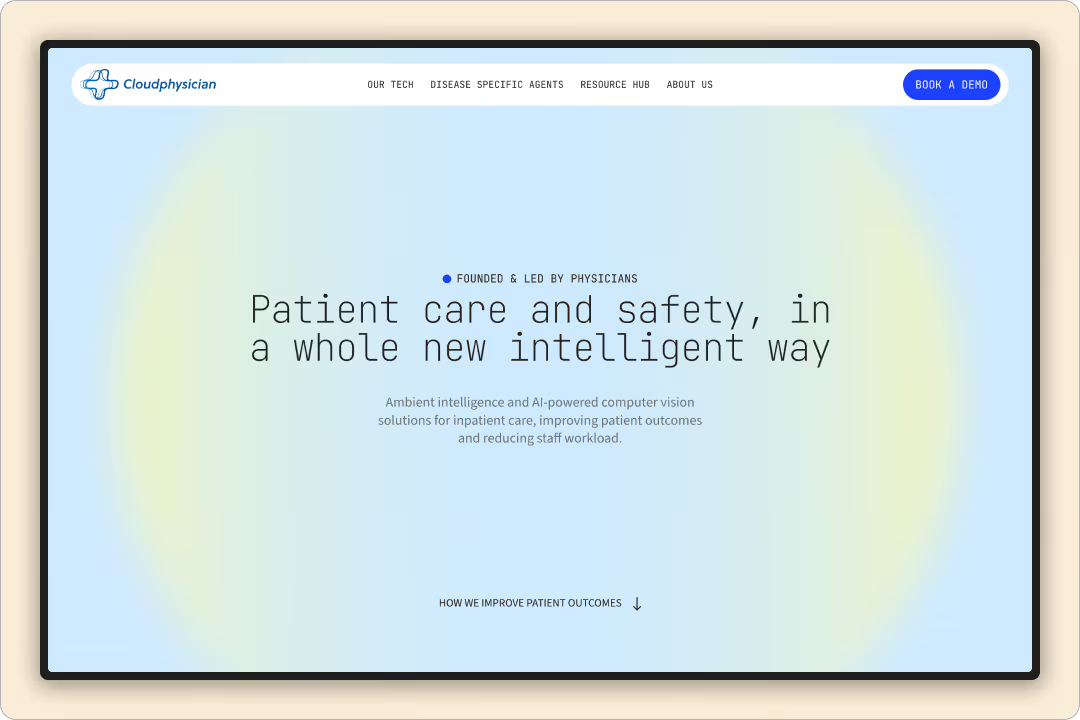
Cloudphysician
Visual branding and website design for Cloudphysician, an AI-powered platform that enhances critical care monitoring
Good Food Movement - Akshaykalpa
Multimedia portal design for Good Food Movement by Akshayakalpa, educating consumers about sustainable food choices


Healthcare Tech Branding
Experts

Ekta Manchanda
Co-Founder | Principal Designer

Mejo Kuriachan
CEO | Partner | Brand Strategist

Athira Krishnan
Lead Designer | Content Strategist

Tanmaya Rao
Lead Brand Designer | Illustrator