


Financial Sector Brand Agency
Financial institutions are built on trust — but in a digital-first world, trust starts with how your brand looks, feels, and communicates online.


How Should Financial Sector Brands Modernize Without Losing Trust?
By evolving the visual language while preserving institutional credibility. We help financial sector brands refresh their identity, messaging, and digital presence to feel contemporary and accessible — without sacrificing the authority and stability that clients expect.
TL;DR
A fintech app, a fund raising an LP round, and a 40-year-old investment bank solve opposite trust problems, so we treat them as three distinct branding jobs.
- FinTech and SaaS-finance: brand identity that reconciles innovation with the trust to hold money. Lead proof: Xpat, an NRI-remittance brand identity.
- VC and fund brands: covered lightly here with Z47's India AI Report landing page as proof. The full LP, founder, and co-investor breakdown lives on our dedicated VC page.
- Traditional institutions and investment banks: investor-grade credibility, shown through PrimeWealth's "advice shaped by alignment, not transaction" and APTA Advisors, benchmarked against US and European boutiques.
We've found 8 in 10 clients return for additional work, drawn from 223 companies. The comparison table below helps you find your segment fast.
Three financial buyer types, three different branding jobs
A fintech app, a fund raising its next LP round, and a 40-year-old investment bank all sell financial services, but they solve opposite problems when they build a brand.
A fintech has to look new enough to justify switching, yet stable enough that customers hand over their money. Push too hard toward disruptive startup and people hesitate. Lean too far into old-guard institution and the reason to switch disappears (Metabrand).
Traditional institutions face the reverse tension. A comparative study of 24 bank landing pages found that established banks lead with stability, experience, and origin, while challengers lead with technology and emotional closeness (Galactica Media). Borrow the wrong playbook and an institutional buyer reads you as a startup that might vanish in 18 months.
VC and fund brands answer to a third audience entirely, which is why we cover them on a dedicated page.
Comparison at a glance
Each segment below solves a different trust problem. Find the row that matches your buyer, note your lead proof point, then read the full segment section for depth.
FinTech & SaaS-finance brands
A fintech faces a harder branding problem than most companies. It has to look new enough to pull customers away from their bank, and steady enough that those customers hand over their money. Push too far toward the disruptive-startup look and people hesitate. Push too far toward the old-institution look and you blend into the banks you're trying to beat (metabrand.digital).
Xpat shows how we resolve that tension in practice. Xpat moves money across borders for NRIs sending funds home, so its identity had to feel dependable to someone wiring their savings and approachable to a first-time sender. The visual system balances both. It reads as careful with money without feeling stiff or cold.
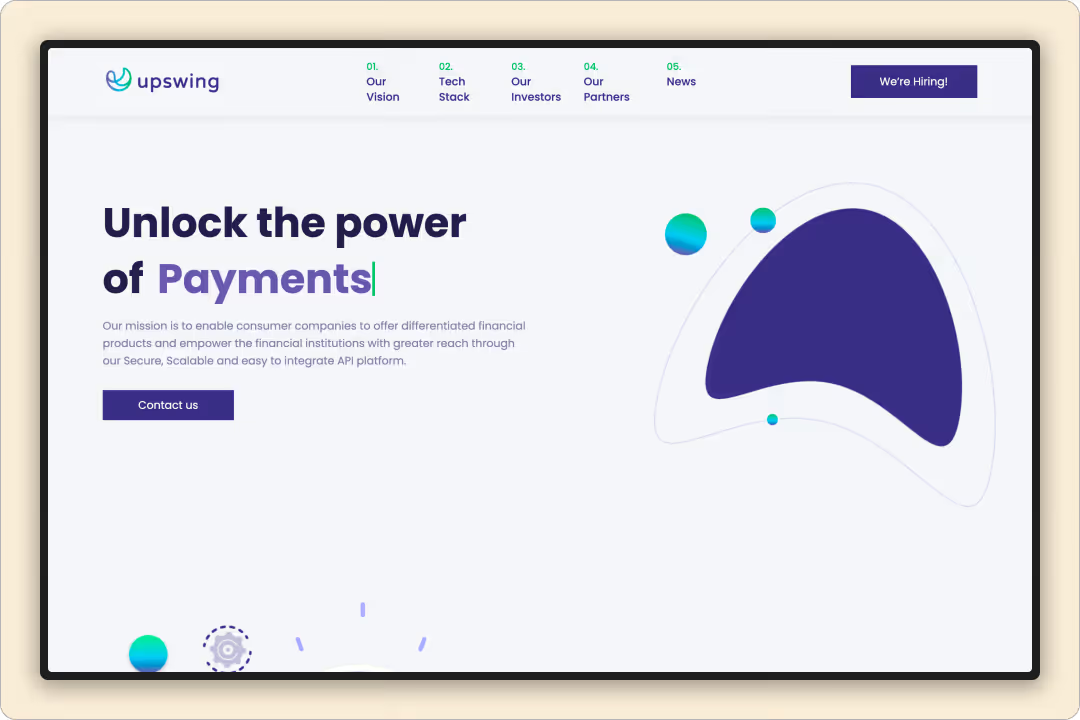
Range across fintech categories matters here, because a payments brand and a lending brand solve different problems. Swiffy Labs, Progcap, and Upswing cover payments, lending, and SaaS-finance between them. Tazapay came back for a second explainer video, and Zuora keeps returning for repeat ad work. We've also handled a confidential merger of three remittance entities into one brand, which is about as complex as fintech consolidation gets.
Consumer, B2B, and infrastructure fintechs each earn credibility differently, and generic financial branding ignores that. A B2C app wins on emotion and word-of-mouth. A B2B platform wins on credentials, customer logos, and enterprise-readiness cues. An infrastructure product wins on developer experience and the caliber of who already builds on it (metabrand.digital). We shape messaging and visuals to whichever of the three you actually are, rather than applying one look to all fintechs. That segment-level depth is where competitors like Dusted and Halo Lab stay generic.
This segment fits payment platforms, neobanks, lenders, remittance apps, and finance-focused SaaS. It's the wrong fit for two adjacent buyers. If you run a VC firm or fund, your brand speaks to LPs and founders, not consumers, and that work lives on our dedicated page. If you're a 40-year-old investment bank, the innovation-forward fintech look actively undercuts you, so read the traditional-institutions segment below instead.
The payoff for getting this right is retention. Everything Design reports that 8 in 10 clients return for additional engagements, and simplicity compounds that. A Siegel+Gale study found 63% of consumers will pay more for simpler experiences (metabrand.digital). Clear beats clever when the product handles money.
VC and fund brands
Funds sell a thesis. For Z47, one of India's oldest venture firms, we built a dedicated landing page for The India AI Report and treated the research itself as the protagonist rather than a download button. A fund's thesis carries more weight with founders and LPs than any logo, and that page put the thinking first. Z47's relationship with us keeps growing, and BEENEXT and Stellaris show the same pattern of repeat, embedded work rather than one-off projects.
We keep this segment short here on purpose. If you want the full breakdown of how a fund brand speaks to LPs, founders, and co-investors at once, plus a deliverables checklist, evaluation criteria, and proof points from Arka VC, Elevar Equity, and IndigoEdge, read our dedicated VC branding page.
Traditional financial institutions and investment banks
Institutional buyers judge a financial brand on sophistication, compliance fluency, and operational maturity, not on how fresh or approachable it looks. A partner at an M&A boutique or an investment bank asks whether you can handle their complexity, whether you understand regulation, and whether you will still be here in three years. A comparative study of 24 bank landing pages found traditional institutions lean on stability, experience, and long-standing affiliations, while challengers push technological novelty and emotional closeness (Galactica Media). Borrowing the challenger playbook actively hurts the institutional buyer.
APTA Advisors shows what investor-grade credibility looks like when it's done right. The Bangalore mid-market M&A firm advises on tech and manufacturing deals, and its clients sit across the table from US and European boutiques. Everything Design rebuilt positioning, logo, full identity, and website around one internal goal: a mark that holds its own against those boutiques. The identity system passed client review in April 2026, and the site went live that June with a leadership photoshoot rather than stock imagery.
PrimeWealth proves that message can carry the differentiation. The investment advisory firm rebuilt its brand and website around a single line, "advice shaped by alignment, not transaction." The design used an editorial layout and slower typography, and it deliberately avoided the stock-photography clichés common to financial services. That approach separates a firm selling advice from one selling products.
Generic fintech visual language undermines this buyer for concrete reasons. Gradients, geometric shapes, isometric illustration, and three-column feature grids read as B2C startup, which reads as a company that might vanish in 18 months (Freshly Brewed). Institutional work runs the other way. A distinctive but restrained color palette, a custom graphic toolkit instead of stock assets, real photography of the team and office, and typography that signals seriousness without turning corporate-dull.
Compliance belongs in the design, not buried in fine print. Regulatory disclosures handled well become a reason to trust a firm rather than a legal burden (Metabrand). Licenses, certifications, leadership visibility, and clear terms build credibility layer by layer when they're treated as part of the brand system. Everything Design's client roster carries institutional weight here, with Bajaj Finserv, HDFC Ergo, State Bank of India, and JPMorgan Chase & Co among named entries, and a second investment-banking rebrand starting in June 2026 confirms this is a recurring vertical.
How the engagement works across segments
Every engagement runs in three phases regardless of segment. Discovery and positioning comes first, where we pin down your thesis, your audience, and the trust problem you actually face. Identity development follows, translating that positioning into a visual and verbal system. The digital build comes last and turns the system into a working site or product surface.
Timelines vary by scope. A focused identity project moves in four to eight weeks, while a full-scope rebrand with strategy, narrative, and a multi-page build runs longer as the discovery phase deepens. Treat these as ranges to plan around, not a fixed quote.
Three things speed the work if you have them ready before we start. Bring your current materials so we see what already exists, and bring competitor context so positioning starts grounded in your market. Most important, name a single decision-maker who can give fast feedback, because branding work stalls when approvals bounce between committees. With those in place, discovery starts on day one instead of week three.
FAQ
How does fintech branding differ from investment bank branding?Fintech branding balances innovation with the credibility to hold someone's money, as with Xpat's cross-border remittance identity. Investment bank branding leans the opposite way, favoring institutional sophistication and compliance fluency over accessibility. Our APTA Advisors rebuild aimed the mark at the US and European boutiques its clients face across the table.
Is VC and fund branding handled on this page?This page gives VC a light summary anchored by Z47's India AI Report. For the full LP, founder, and co-investor breakdown, deliverables checklist, and FAQ, visit our dedicated VC page.
What makes a financial brand both compliant and distinctive?Bring legal into the work early, so disclosures become part of the design instead of hidden fine print. Distinctiveness comes from message and craft, like PrimeWealth's "advice shaped by alignment, not transaction," built with editorial layout and no stock-photo clichés.
What is a typical engagement timeline?Most projects run through discovery and positioning, then identity, then the digital build. APTA Advisors moved from identity review in April to a live site in June 2026, a common shape for a full rebrand.
Are early-stage fintechs and established institutions both a fit?Yes. Everything Design has shipped named work across FinTech, VC, asset management, and investment banking in a single three-month window, and reports that 8 in 10 clients return for additional engagements across 223 companies worked with.
Conclusion
The right proof point depends on which buyer you are. If you run a fintech, Xpat shows how we reconcile cross-border trust with approachability. If you lead a fund, Z47 and the dedicated VC page carry the depth. If you run an advisory or investment bank, APTA Advisors and PrimeWealth prove investor-grade credibility. Tell us which one you are, and we will point you to the closest match. Start a conversation.
Financial Sector Brand Projects

Swiffy Labs
Brand and website design for Swiffy Labs, a modular fintech lending infrastructure platform

Progcap
Brand and website design for Progcap, a fintech platform enabling supply chain financing for underserved retailers

Financial Sector Branding
Experts

Akhilesh J
Lead Designer

Ekta Manchanda
Co-Founder | Principal Designer

Mejo Kuriachan
CEO | Partner | Brand Strategist

Sanjana
Lead Designer

Tanmaya Rao
Lead Brand Designer | Illustrator